
 By
By
Content marketing isn't just "creating content." It’s a strategic system designed to build trust and drive profitable action. Here is what it actually is.
1.The Definition Beyond the Buzzwords
Most people define content marketing as "writing blogs" or "making videos." In reality, those are just the delivery vehicles.
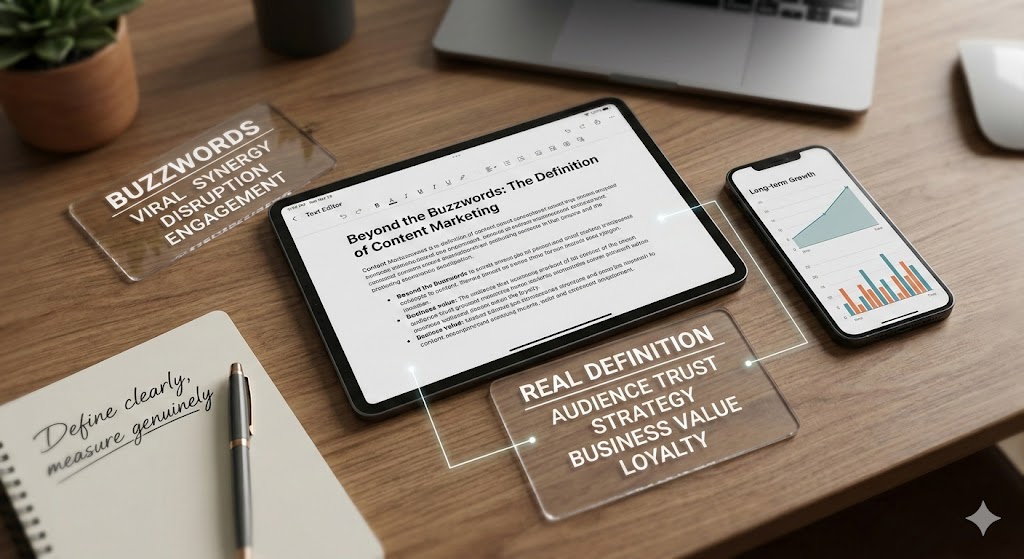
True content marketing is the strategic process of creating and distributing valuable, relevant, and consistent content to attract and retain a clearly defined audience—and, ultimately, to drive profitable customer action. It is the art of communicating with your customers and prospects without selling. It is non-interruption marketing.
The Death of Interruption
Traditional marketing is built on interruption—commercials that stop your show, or pop-ups that block your reading. Content marketing is the antidote. It is the practice of earning attention rather than buying it.
Defining the "Owned" Audience
The core of content marketing is moving people from "rented" platforms (like LinkedIn or Instagram) to "owned" platforms (like an email list or a proprietary resource center).
The Strategic Definition: > Content Marketing is a long-term strategy focused on building a strong relationship with your target audience by giving them high-quality content that is very relevant to them on a consistent basis.
2.The Critical Difference: Content vs. Content Marketing
This is where 90% of companies fail. They create "content" but they don't do "marketing."
What is "Just Content"?
Content is a commodity. It’s a 500-word blog post written because "we need to post something on Tuesday." It lacks a call to action (CTA), it doesn't solve a specific pain point, and it isn't tracked back to a business goal.
What is "Content Marketing"?
Content marketing is content with a mission. * Intentionality: Every piece of content is a brick in a wall.
- Audience-Centricity: It’s not about what the company wants to say; it’s about what the customer needs to hear.
- The Conversion Path: It guides the reader to the next logical step in their journey.
The "Authority" Gap
For a professional profile, your content must bridge the "Authority Gap." This is the distance between a lead knowing you exist and a lead trusting you enough to hire you. High-level content marketing closes this gap by proving your expertise before a contract is ever signed.
| Content | Content Marketing |
| Raw material | Architectural blueprint |
| Reach | Revenue |
| Half-Life | Longevity |
| Feature | Mere "Content" |
Strategic "Content Marketing"
|
|
| Primary Goal | To fill a gap or "post something." |
To drive a specific, profitable customer action.
|
|
| Focus | Product-centric (What we do). |
Audience-centric (How you win).
|
|
| Lifespan | Temporary/Ephemeral (Social posts, news). |
Evergreen/Compounding (Guides, Resource hubs).
|
|
| Measurement | Vanity Metrics (Likes, Shares, Views). |
Business Metrics (Leads, ROI, Sales Cycle length).
|
|
| Structure | Isolated pieces or "one-offs." |
A connected ecosystem (The Funnel).
|
|
| Distribution | "Post and Pray" (Hoping for reach). |
Multichannel Strategy (SEO, Email, Paid, Social).
|
|
| The Outcome | Brand Noise. |
Brand Authority & Owned Audience.
|
|
3.The Three Pillars: Value, Consistency, and Relevance
To move the needle, your strategy must rest on these three pillars:
- Value: Does this solve a problem or answer a question for the reader?
- Consistency: Are you showing up often enough to build an "owned" audience?
- Relevance: Is the content tailored to the specific person you want to do business with?
Pro Tip: If your content could be swapped with a competitor’s logo and still make sense, it isn't specific enough.
4. The Strategic Connection: Content Meets the Funnel
Content marketing works because it respects the buyer's journey. You cannot ask for a sale before you’ve provided value.
To truly understand content marketing, you have to see it as a map. Let's break down the TOFU, MOFU, and BOFU stages.
Top of Funnel (TOFU): The Awareness Stage
At this stage, the user doesn't know you. They have a problem, and they are searching for a solution.
- Format: "The Ultimate Guide to..." or "10 Reasons Why Your [X] is Failing."
- Goal: Traffic and Brand Recall.
Middle of Funnel (MOFU): The Consideration Stage
The user knows who you are, but they are comparing you to others.
- Format: Comparison charts, Case Studies, and "Behind the Scenes" deep dives.
- Goal: Lead Generation (Email sign-ups).
Bottom of Funnel (BOFU): The Decision Stage
The user is ready to buy but needs a final nudge.
- Format: ROI Calculators, Implementation Guides, and Testimonials.
- Goal: Sales and Revenue.
.jpg?width=1408&height=768&name=unnamed%20(1).jpg)
5. Measuring What Matters: Attributing ROI to Content Assets
Junior marketers talk about "Reach." Senior strategists talk about "Revenue."
Vanity Metrics vs. Clarity Metrics
- Vanity: Likes, Followers, Page Views.
- Clarity: Time on Page, Scroll Depth, Lead Conversion Rate.
The "Content Asset" Mindset
In a professional profile blog, you must explain that content is an asset, not an expense.
- An ad stops working the second you stop paying for it.
- A high-quality guide (like this one) continues to bring in leads for years. This is the compounding return of content marketing.
Final Thought: Content is the New Sales Force
In the modern economy, your content is your sales team that never sleeps. It answers questions at 3:00 AM, it handles objections before a call starts, and it builds a reputation for you while you're busy working on other projects.
That is what content marketing actually is.
So Stop Guessing. Start Scaling.
Most businesses are shouting into a void of "content" without a "marketing" map. After 10 years of building content ecosystems that drive revenue, I know that the difference between noise and ROI is a single, documented strategy.
Ready to turn your content into a compounding business asset?
Frequently Asked Questions About Content Marketing
1. How long does it take to see results from content marketing?
In my 10 years of experience, I’ve found that content marketing is a "compounding interest" play. While you might see social engagement immediately, significant organic SEO traffic and lead generation typically take 3 to 6 months of consistent execution. Unlike paid ads, which stop the moment you stop paying, content continues to deliver ROI for years.
2. Do I need to be on every platform (LinkedIn, TikTok, X, etc.)?
Absolutely not. Strategic content marketing is about relevance over reach. It is far better to be authoritative on one platform where your "Ideal Customer Profile" (ICP) actually hangs out than to be mediocre on five platforms where they don’t. Focus on where the decision-makers are.
3. Is content marketing only for B2B companies?
No. While the sales cycles differ, the psychology remains the same.
- B2B: Content focuses on ROI, efficiency, and risk mitigation.
- B2C: Content focuses on lifestyle, status, and solving immediate personal pain points. Both require a journey from "Stranger" to "Advocate."
4. How do I come up with content ideas consistently?
The best ideas don't come from "brainstorming"—they come from listening.
- Audit your sent folder: What questions are you constantly answering for clients?
- Consult your sales team: What are the top three objections they hear?
- Search listening: Use tools to see what specific problems your audience is searching for in 2026.
5. Can AI replace my content marketing strategy?
AI is a powerful accelerator, but it is not a strategist. AI can help you draft sections or optimize for SEO, but it lacks the "human-to-human" authority and the decade of nuanced industry experience you bring to the table. In a world flooded with AI-generated "noise," high-level, expert-led content is actually more valuable than ever.